Mold Removal in Downtown North Las Vegas, NV
Downtown North Las Vegas is the original town: the blocks around Lake Mead Boulevard and Las Vegas Boulevard North that Thomas L. Williams laid out on 160 acres in 1919, where the city incorporated on May 1, 1946, and where City Hall and the main library now stand on Las Vegas Boulevard North. The houses are the oldest in the city, 1940s to 1960s block and wood-frame bungalows and 1970s stucco ranches on slabs, many with a roof-mounted evaporative cooler that was the only cooling for decades.
In a house this age the mold source is almost always the original plumbing: a copper or galvanized line under the slab that has pinholed, a cast-iron drain that has rusted through, or the drain pan and down-duct of an old cooler that leaked into a ceiling for years. The stain is on a hall wall base or a kitchen floor; the water is under the slab.
Homeowners in Downtown North Las Vegas reach an independent local mold provider through this site's phone line. The provider meters the rooms and tells you what has to come out. We make the connection, nothing else.
Old Town mold removal over a slab line
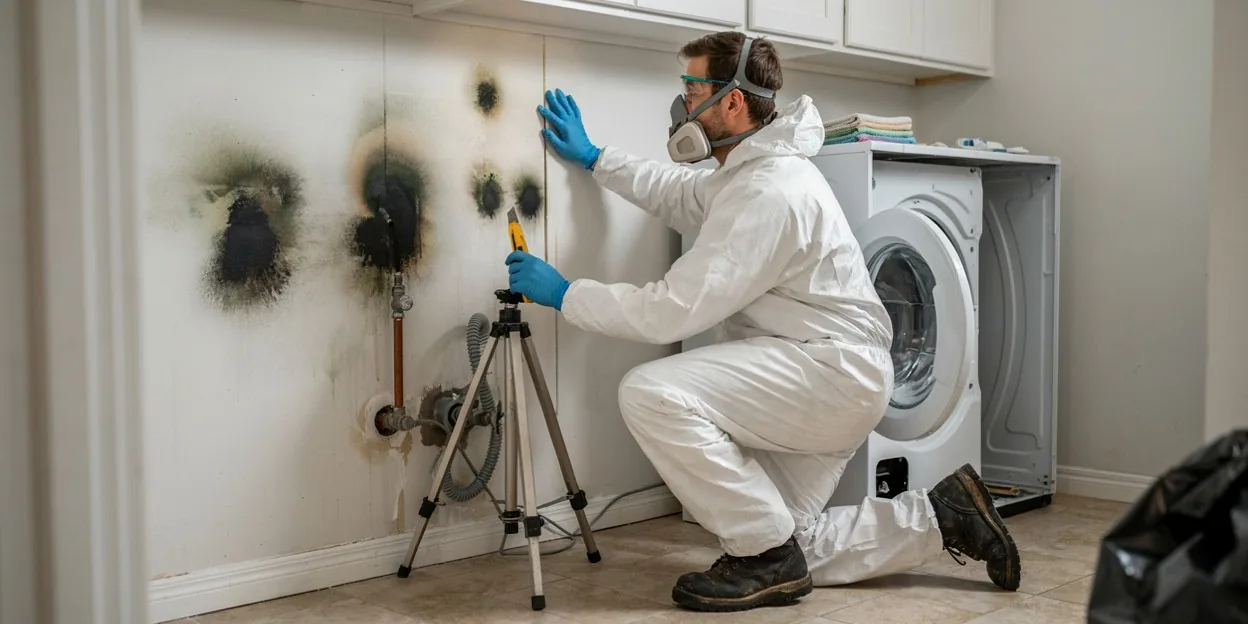
A soft kitchen floor or a stained wall base with no fixture nearby is mold removal, with the meter on the slab to find the wet edge before anything is pulled. A gray bloom on a ceiling under where the cooler used to sit is attic mold remediation if the sheathing is involved. A smell in a hall closet that holds the water heater is mold odor removal.
The hospital on Lake Mead Boulevard
North Vista Hospital has stood on East Lake Mead Boulevard since 1959 and is the emergency room for the old city and the Nellis corridor. Many of the houses within a mile of it were built in the same decade.
Call (725) 353-7567 and describe the leak and the growth. We put you through to a local mold provider serving Downtown North Las Vegas.
Services Available in Downtown North Las Vegas
Mold Removal
Growth on drywall under a second-floor bath, behind a kitchen sink, or along a slab-leak wall: room sealed, wet board cut to the meter mark, framing cleaned and dried.
Black Mold Removal
A dark patch handled by where the water went, not what shade it is: containment first, porous material out, hard surfaces cleaned, the source fixed before closing.
Whole-Home Mold Remediation
A supply line that ran for weeks in a shut-up house, or storm water across the slab, mapped room by room and worked in zones as one project.
HVAC Mold Cleaning
Coil, pan, drain line, and plenum cleaned when the attic air handler sweats through a North Las Vegas summer and the house smells sour at startup.
Bathroom Mold Removal
Growth behind a vanity, under a shower pan, or on a fanless ceiling, removed after the drain or supply leak feeding it is repaired.
Attic Mold Remediation
Sheathing and truss growth from a sweating duct, a failed roof vent, or a flashing leak, cleaned and treated once the moisture path is closed.
Mold Odor Removal
A musty smell in a house that looks dry, traced with a meter to the wet pad, plate, or cabinet back, then removed and treated at the source.
Mold Damage Repair
Drywall, texture, baseboard, insulation, and cabinet bottoms rebuilt after removal, once the slab and framing read dry and the leak is fixed.